
Liquid Cooling Is Moving Downmarket — What It Means for Aluminium Component Suppliers
Once confined to data centres, liquid cooling is now appearing in EV chargers, industrial inverters and high-power electronics. Here is what the shift demands from aluminium cold plate manufacturers.
That is changing. As power densities rise across electric vehicle charging, industrial power electronics, renewable energy inverters and high-performance computing, air cooling is running out of headroom in a widening set of applications. Liquid cooling is moving from niche to mainstream.
For aluminium component manufacturers, this represents a meaningful shift in what customers need.
Why air cooling hits a wall
Air has a low volumetric heat capacity. Moving enough air to remove large heat loads requires large fin surface areas and substantial airflow — which means noise, space and energy consumption.
As a rough illustration: air cooling handles tens of watts per component comfortably. Liquid cooling handles kilowatts. When a single power module or processor generates several hundred watts, air cooling stops being an engineering trade-off and becomes a physical limit.
The transition point is not fixed — it depends on duty cycle, ambient temperature, allowable temperature rise and envelope. But across more industries, that point is being crossed.
What changes for aluminium components
Liquid cooling shifts the design problem from surface area to conduction path and sealing.
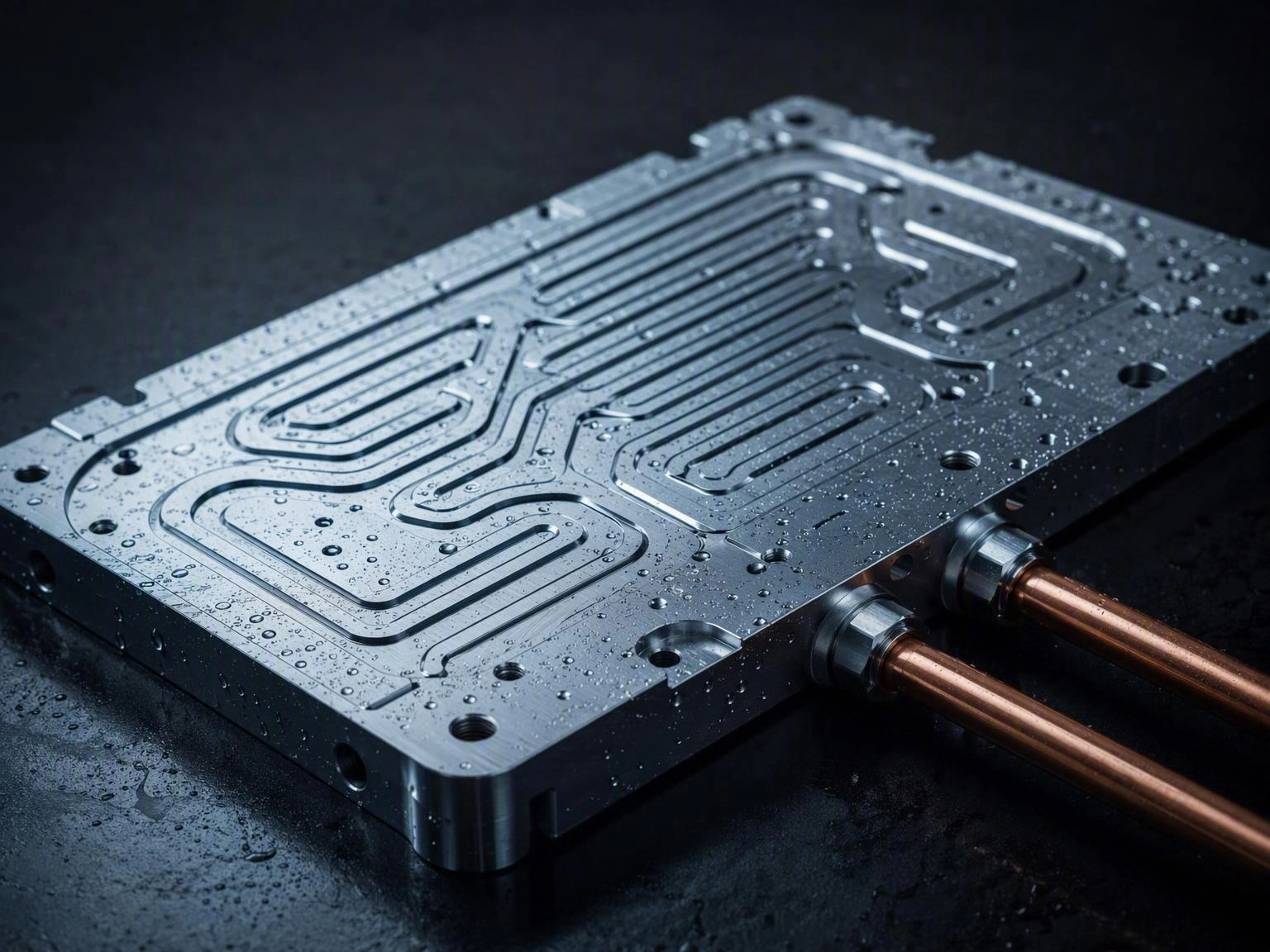
An air-cooled heat sink optimizes fin area and airflow. A liquid-cooled cold plate optimizes:
- - Internal channel geometry — micro channels, pin fins or serpentine paths that maximize contact between coolant and metal
- - Wall thickness between channel and device — thin enough for heat transfer, thick enough to contain pressure
- - Flatness at the device interface — critical, because a liquid cold plate has no airflow to compensate for a poor contact patch
- - Sealing integrity — the part must contain coolant at pressure for years without leaking
- - Fitting and port geometry — matched to the customer's coolant loop
This places very different demands on the manufacturing process. CNC machining capability and dimensional precision become more important than fin-forming capability.
The processes involved
Aluminium liquid cooling components typically use:
- - Machined cold plates — channels cut into a solid aluminium block, then a cover plate bonded or friction-stir welded. Best for complex channel geometries and low-to-medium volume.
- - Extruded tube with machined features — for simpler, straight channel designs where extrusion economics apply.
- - Die cast housings with machined coolant passages — for high volume integrated assemblies, with careful attention to porosity in pressure-containing walls.
- - Skived or bonded fin assemblies — where a hybrid air/liquid approach is required.
Because we run CNC machining, die casting, extrusion and surface treatment in-house, we can evaluate which route suits a given cold plate rather than forcing it into a single process.
The porosity problem
Here is where liquid cooling separates competent manufacturers from optimistic ones.
A die cast housing used for air-cooled duty tolerates modest internal porosity — it affects thermal performance slightly but the part still functions. The same porosity in a coolant-containing wall becomes a leak path. Under thermal cycling and pressure fluctuation, small voids become cracks.
For any pressure-containing aluminium part, porosity must be controlled and verified, not assumed. This means controlled die design, process parameter discipline, and for critical parts, pressure testing or leak testing before shipment.
If you are sourcing a die cast cold plate or coolant housing, ask directly: how is porosity verified in the sealing walls, and is pressure testing performed?
What is coming next
Three trends are visible from our side of the supply chain.
Higher voltages. EV charging is moving to 800 V architectures, which increases thermal loads on power modules and makes liquid cooling standard rather than optional in chargers.
Tighter integration. Instead of a separate cold plate bolted to a power module, designs increasingly integrate cooling directly into the module housing. That demands manufacturers who can combine casting, machining and sealing in one part — a vertical integration problem.
Materials scrutiny. As coolant chemistries evolve (glycol mixtures, dielectric fluids), compatibility with the aluminium alloy and the chosen surface treatment becomes a qualification question. Anodizing and coating choices affect corrosion behaviour in a wet loop in ways they do not in dry applications.
What this means if you are buying
If your next project involves liquid cooling, the specification conversations have shifted. Bring us the thermal load, allowable pressure drop, coolant type, operating pressure, and interface dimensions — and involve the manufacturer early enough to discuss channel geometry and sealing, rather than issuing a fully specified drawing that cannot be manufactured economically.
Developing a liquid-cooled aluminium component? Contact [email protected] with your thermal and mechanical requirements for a manufacturability and cost review.
Keywords: aluminium cold plate manufacturer, liquid cooling heat sink supplier, EV charger thermal management, micro channel cold plate, liquid cooling aluminium components China