
EV Thermal Management: The Aluminium Components Behind It
Battery cooling plates, PTC auxiliary heaters, power module heatsinks — electric vehicles consume more aluminium thermal components per vehicle than combustion cars. A supplier's view of the EV supply chain.
An electric vehicle has the opposite problem. It produces heat in places where combustion cars do not (battery packs, power electronics, motors), and it has almost no waste heat available for cabin heating. Both problems are solved with aluminium components.
The four thermal zones of an EV
1. Battery pack thermal management
Batteries operate in a narrow comfortable temperature band, typically around 20–40 °C. Below that range, capacity and charging speed drop. Above it, degradation accelerates and thermal runaway risk rises.
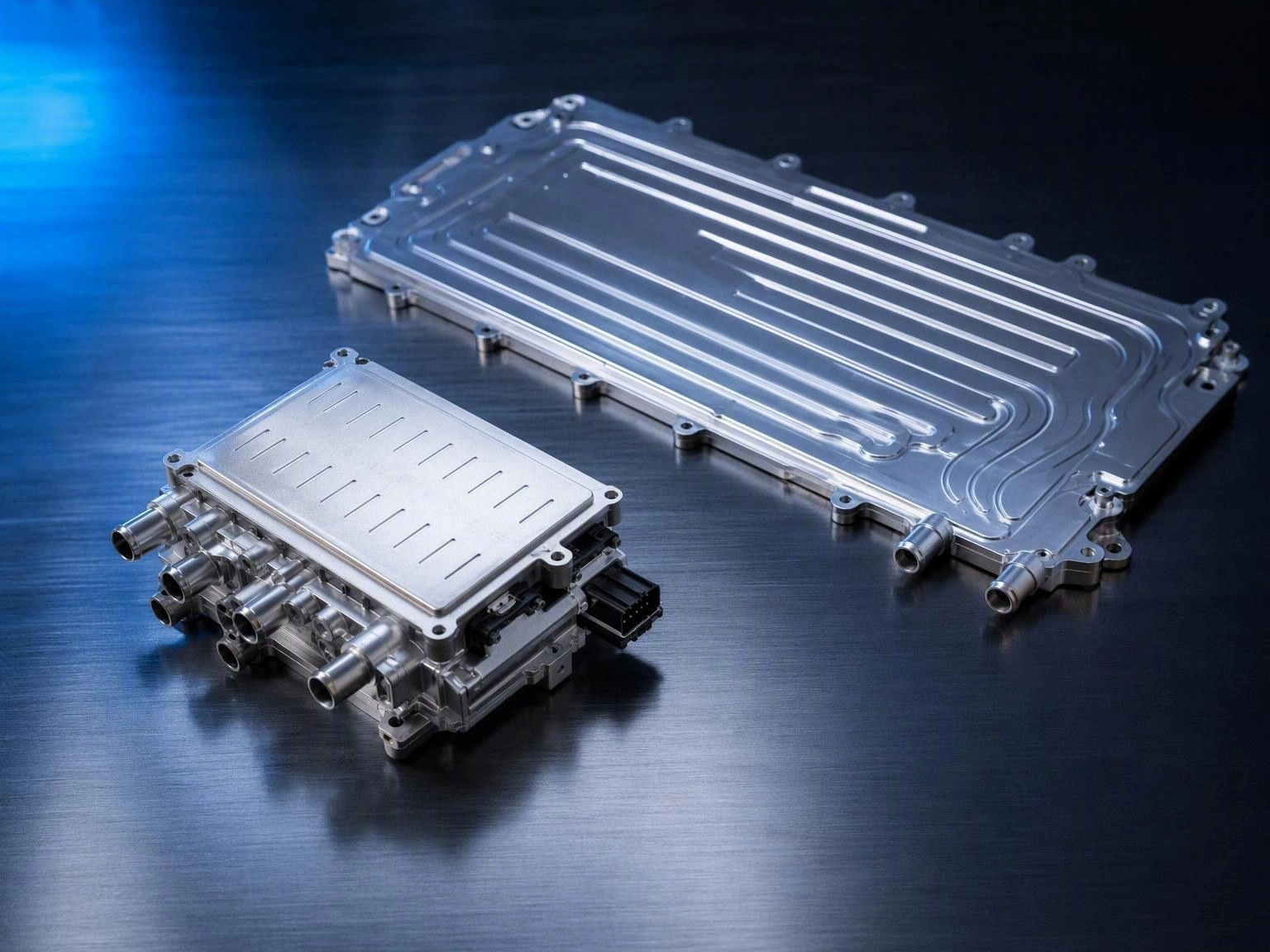
The hardware solution is a cooling plate — often a machined or extruded aluminium cold plate with serpentine coolant channels — placed against the module or between cell rows. Some designs use a refrigerant-based plate for direct cooling; others circulate glycol mixture.
Requirements are demanding: high flatness for good thermal contact, leak-tight channels under pressure, low weight, and long-term corrosion resistance in a wet loop.
2. Power electronics cooling
Inverters, onboard chargers and DC-DC converters are the components that convert and manage electrical power. They generate concentrated heat loads at high power density.
These are typically cooled by machined aluminium cold plates or pin-fin heatsinks, sometimes direct-bonded to the semiconductor module for minimal thermal resistance. Tolerance and flatness requirements here are the tightest in the vehicle.
3. Cabin heating
This is the EV-specific challenge. Without engine waste heat, cabin heating must be generated electrically — which consumes battery range.
Heat pump systems are the efficient answer, but their capacity drops as ambient temperature falls. The supplement is a PTC auxiliary heater: a positive-temperature-coefficient resistive element that provides additional heating when the heat pump alone cannot meet demand.
We hold patent 2025204753583 on a new-energy vehicle heat pump auxiliary PTC heater design. The engineering challenge is delivering fast response and precise control while maintaining a fail-safe thermal profile — PTC elements self-limit their temperature by design, which is precisely why they are used in this role.
4. Motor and drivetrain cooling
Electric motors and their controllers generate heat under load. Cooling is often integrated with the same coolant loop serving the battery and power electronics, requiring components that share a common thermal architecture.
Why aluminium dominates
Three reasons explain why aluminium, rather than copper or steel, dominates EV thermal components.
Weight. Every kilogram matters for range. Aluminium's strength-to-weight ratio makes it the default for structural thermal parts.
Thermal conductivity. At roughly 200 W/m·K for common alloys (6063, 6061), aluminium conducts heat well enough for most thermal paths without copper's weight and cost penalty.
Formability and cost. Aluminium extrudes, casts, machines and anodizes easily and at lower cost than copper. Copper remains the choice for the smallest, most performance-critical thermal paths, but aluminium handles the bulk of the volume.
What the supply chain needs
EV thermal components are automotive components, and the automotive quality expectations apply in full: IATF 16949, PPAP documentation, traceability, process capability data, change control.
Beyond documentation, three manufacturing capabilities matter:
- - Flatness control at the interface. A battery cooling plate that is not flat leaves air gaps and creates hot spots. Achieving flatness on a large thin aluminium plate is genuinely difficult and requires controlled machining and handling.
- - Pressure-tight channel sealing. Whether machined-and-bonded, friction-stir welded or cast, the coolant path must hold pressure over years of thermal cycling.
- - Weight reduction without compromising stiffness. Thin walls, integrated stiffening ribs and cast-in features all serve range, and all demand process control.
Where a manufacturer fits in
An EV thermal program typically involves a customer with a defined thermal target and envelope, and a manufacturer who must translate that into a producible part. The most productive conversations happen when the manufacturer is involved before the drawing is frozen.
Questions worth raising early: What flatness can realistically be held on a plate of this size? Is extrusion or a machined-and-bonded construction more economical at this volume? Should the coolant channel be cast or machined? What surface treatment is compatible with the chosen coolant chemistry?
Because we hold IATF 16949 and run extrusion, die casting, CNC and surface treatment in one facility, these questions can be answered by one team rather than coordinated across four suppliers.
Working on an EV thermal component? Send your thermal and mechanical requirements to [email protected] — early-stage enquiries are welcome.
Keywords: EV thermal management components, battery cooling plate aluminium, PTC heater manufacturer China, new energy vehicle heat sink, aluminium components for electric vehicles