Why LED Thermal Design Still Decides Whether a Luminaire Lasts
LED efficiency has improved dramatically, but every luminaire still depends on a heat sink to hit its rated life. A practical look at heat sink design for LED lighting.
That residual heat is the design problem. An LED's junction temperature determines its output, its colour consistency and its lifespan. Run a junction too hot and you get colour shift, reduced lumen output and dramatically shortened life. Fail to manage it and you have a luminaire that meets specification on day one and disappoints in year two.
The heat sink is where that promise is kept or broken.
Why thermal design drives rated life
LED manufacturers specify rated life — commonly 50,000 hours — at a defined junction temperature, typically 85 °C or lower. Operating above that temperature degrades the device faster, and the relationship is not linear.
A commonly cited rule of thumb holds that for every 10 °C reduction in junction temperature, LED life roughly doubles. Whether or not that exact figure applies to a given device, the direction is unambiguous: cooler means longer.
Junction temperature depends on three things: the heat the device generates, the thermal resistance from junction to ambient, and ambient temperature. The heat sink addresses the thermal resistance path — and it is usually the most controllable variable.
The thermal path
Heat travels from the LED die through the package, the solder joint or thermal interface material, the PCB (often a metal-core PCB for high-power designs), the mounting interface, and then into the heat sink before finally dissipating to air.
Every interface in that chain adds resistance. The heat sink's job is to provide sufficient surface area and an efficient conduction path from the mounting surface to the fins.
Two failure patterns recur in the field:
Insufficient fin surface area. The heat sink is undersized for the actual power dissipation — often because the design assumed ideal conditions rather than the enclosed, dusty, high-ambient realities of the installation.
Poor interface contact. The heat sink is adequately sized, but poor flatness or inadequate clamping leaves a gap at the mounting interface. The thermal resistance added at that single interface can exceed the resistance of the entire heat sink.
Heat sink forms for LED lighting
Extruded profile heat sinks — the most common choice. Constant cross-section, straight fins, cut to length. Economical, thermally effective, and available in a wide range of standard profiles plus custom dies.
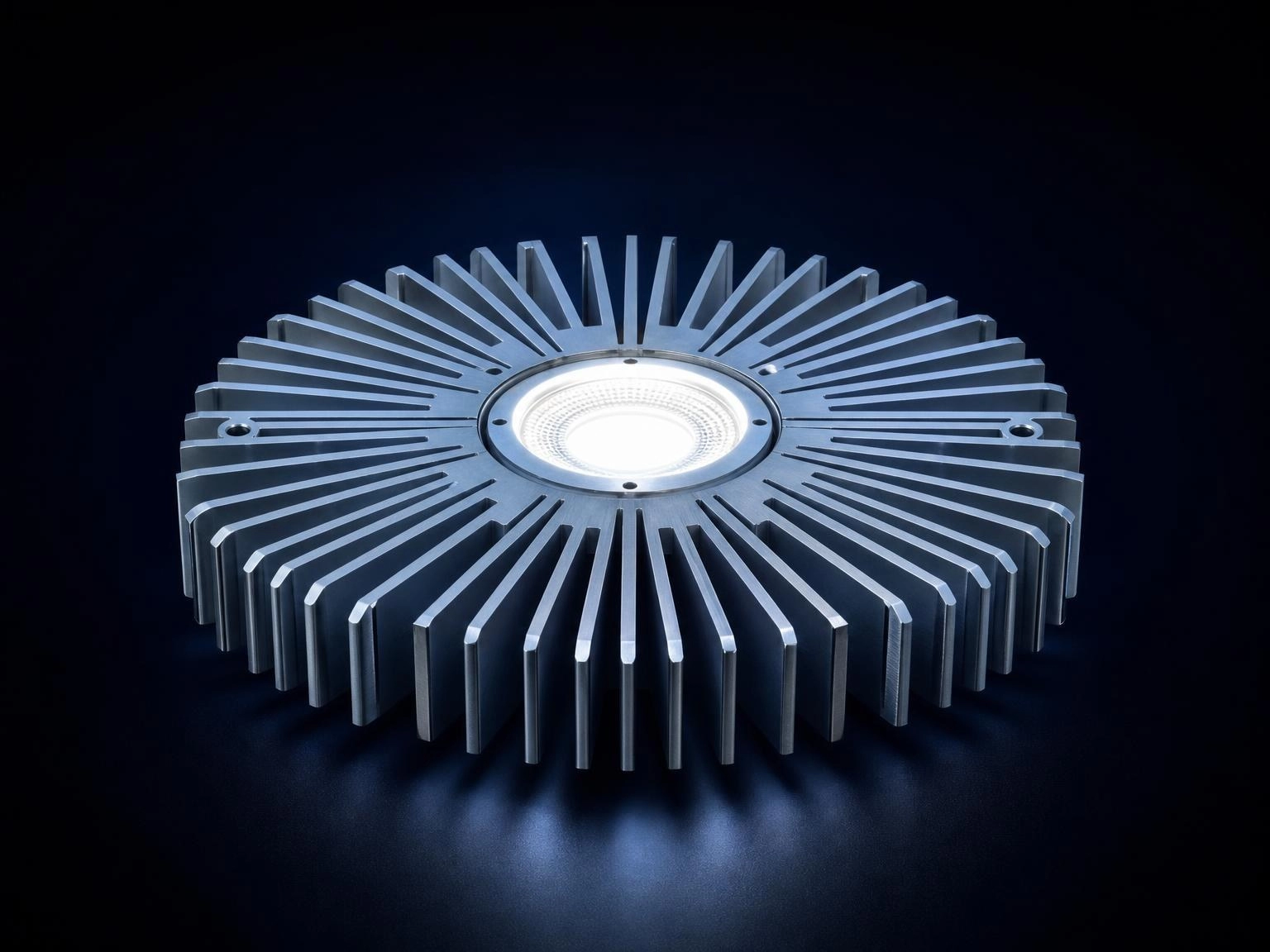
Radial (round) fin heat sinks — fins radiate from a central hub, typically for round luminaires such as downlights and high-bay fixtures. Effective when airflow is unrestricted in all directions and the fixture geometry is circular.
Die cast heat sinks — used where the heat sink doubles as the luminaire housing, integrating mounting points, driver compartment and optical mounting features into one part.
Skived fin heat sinks — fins formed by slicing from a solid base, allowing very thin, tall fins with no bond-line resistance. Higher cost, better performance density.
Pin fin heat sinks — cylindrical pins rather than flat fins; suited to applications with omnidirectional or low-velocity airflow.
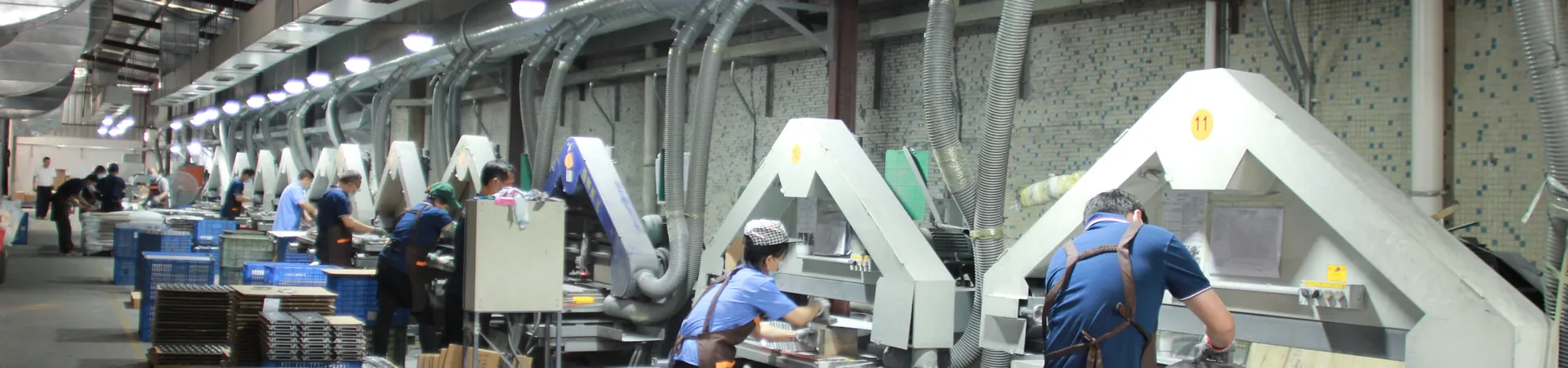
We manufacture extruded LED heat sink profiles, radial fin designs, die cast LED and communication components and other custom profile heat sinks — with CNC machining for mounting features and tapping, plus the full range of surface finishes.
Design guidance that actually matters
Match the heat sink to the real environment. A luminaire designed for an air-conditioned office and deployed in an unconditioned warehouse with solar loading will not perform as modelled. Specify ambient conditions honestly.
Prioritize the interface. Ensure the mounting surface is flat, use the correct thermal interface material, and maintain adequate clamping pressure. Improving the interface is often cheaper than enlarging the heat sink.
Leave room for airflow. Heat sink performance assumes air can reach and leave the fins. Confined enclosures, tight recesses and dust accumulation all degrade performance.
Consider convective direction. Vertical fin orientation promotes natural convection. Orient fins along the airflow path in forced-air designs.
Account for finish. Anodizing improves corrosion resistance but adds thermal resistance at the surface. For high-performance designs, consider masking critical thermal surfaces or limiting the coating thickness.
Prototype and measure. Thermal modelling is valuable but imprecise. A prototype with thermocouples at the junction, board and heat sink will tell you more than any simulation.
The commercial reality
LED lighting is a competitive, price-driven market. That pressure pushes toward thinner fins, smaller heat sinks and cheaper alloys — all of which reduce thermal margin.
We see the consequences when customers arrive with field failures or warranty returns. The correction is usually a redesigned heat sink, and by then the tooling, the certification and the inventory have all been committed.
Involving the heat sink manufacturer during thermal design — rather than after the luminaire is specified — is the cheapest insurance available.
Designing an LED luminaire? Send your LED power, target junction temperature, ambient conditions and envelope to [email protected] for a heat sink recommendation.
Keywords: LED heat sink manufacturer, LED thermal management, extruded aluminium LED heatsink, LED luminaire cooling, radial fin heat sink China