Zhihong Die Casting Division: High-Volume Aluminium Parts Without the Quality Drift
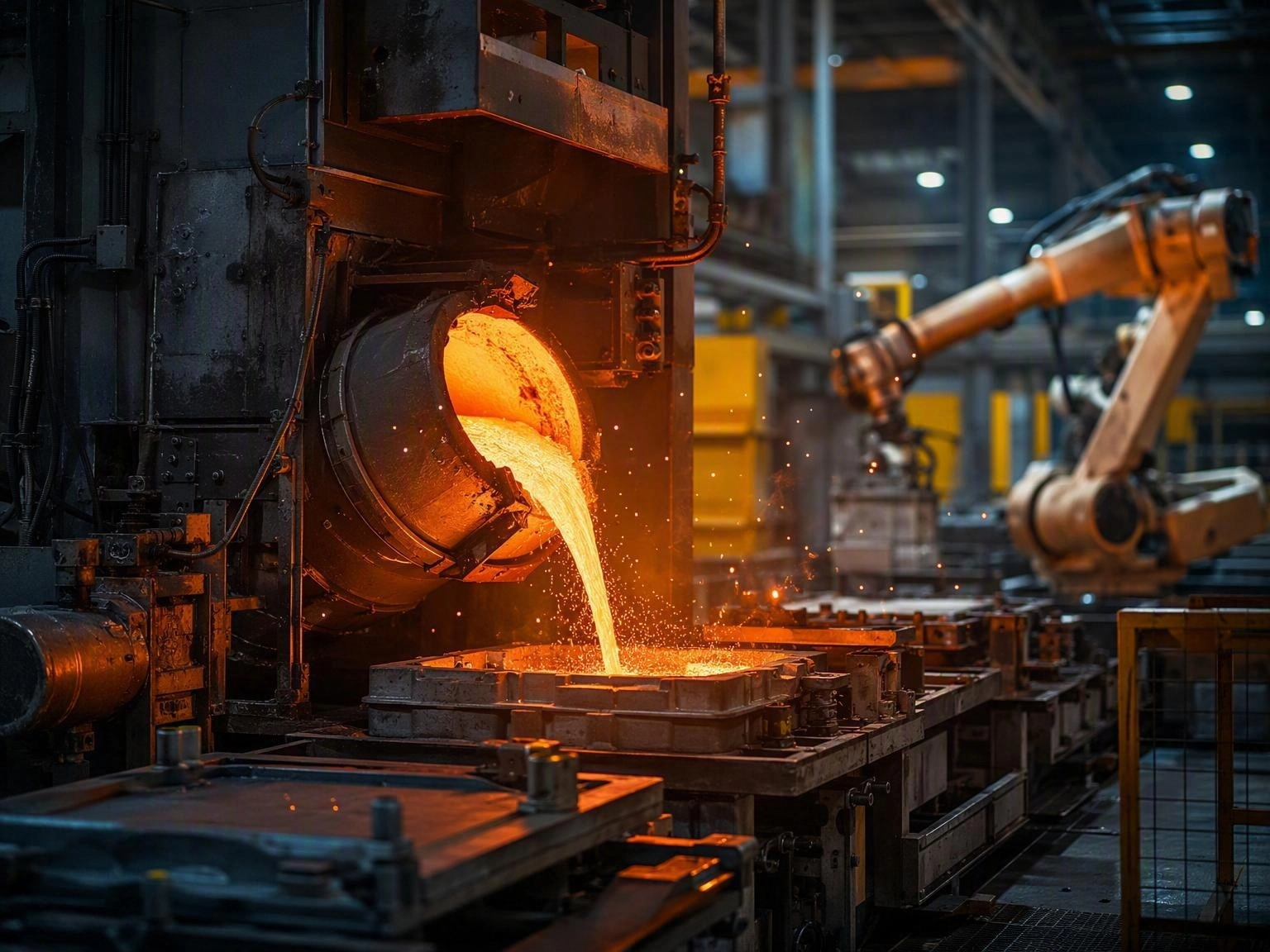
In 2019 we stopped subcontracting die castings and built our own foundry. Here is what the robotic production lines changed — and which parts they suit best.
Everything else — extrusion, machining, stamping, anodizing, coating, assembly — happened inside our own plant. But when a project needed a cast housing, we sent the tooling out. And when the castings came back with porosity, cold shuts or dimensional drift, the conversation became difficult: we were accountable to the customer for a process we did not run.
In September 2020 we fixed that by establishing Zhihong Die Casting Technology, our dedicated die casting division.
What the division runs
Zhihong operates multi-station die casting machines with automated robotics, fully automatic production lines and supporting equipment. That configuration is aimed at a specific goal: repeatability at volume.
Manual die casting depends heavily on operator technique — ladle timing, shot speed, die temperature control. At low volume that is manageable. At high volume it produces the steady drift that quality engineers spend their weeks chasing.
Automation locks those variables down. Cycle time becomes consistent, die temperature is regulated rather than estimated, part handling stops being a labour variable, and the process produces a statistically stable output that a capability study can actually support.
We also run a complete post-casting chain in-house: trimming, shot blasting, CNC machining of critical features, and surface treatment. A casting does not have to leave the plant to become a finished part.
What die casting is good for
Die casting is the right process when your part has:
- - Complex, non-uniform geometry — ribs, bosses, mounting ears and internal features that extrusion cannot produce
- - High volume — tooling cost amortizes quickly once annual volumes support it
- - Integrated features — features that would be separate machined parts can be cast in place, reducing assembly
- - Thin, stiff walls — good stiffness-to-weight ratio for housings and enclosures
Typical parts we produce include LED lighting components, communication equipment housings, smart lock and digital accessory bodies, and automotive audio and home amplifier parts.
Where extrusion still wins
Die casting is not universally better, and any supplier who says otherwise is selling tooling rather than solutions.
If your part is a straight heat sink profile with uniform fins, extrusion is cheaper per kilogram, produces better thermal conductivity with fewer internal defects, and requires less tooling investment. We run both processes and will tell you which one your part actually needs.
A useful rule of thumb: complexity favours casting; length and uniformity favour extrusion.
The alloy question
For die casting we work in standard casting alloys — ADC12 / A380 for general purpose parts where castability and cost dominate, and A360 / ADC10 where better corrosion resistance and slightly higher strength are needed.
If your application requires higher thermal conductivity than a casting alloy provides, extrusion in 6063 or 6061 is usually the better answer. We will flag this during quoting rather than after the first shipment.
Porosity: the honest version
Porosity exists in every die casting. The question is how it is managed.
We control it through die design (gate and overflow placement), process parameters, and — when a part must be pressure-tight or structurally critical — through vacuum-assisted casting. For cosmetic or sealing surfaces we define which areas are porosity-critical, and we machine or seal those zones where required.
If a supplier promises zero porosity in a die casting, they are either not measuring it or not telling you the truth.
Have a die cast component in mind? Send your 3D model and annual volume to [email protected] and we will advise whether casting or extrusion is the better route for your part.
Keywords: aluminium die casting manufacturer China, ADC12 die cast parts, OEM die casting supplier, die cast housing manufacturer, aluminium alloy casting Dongguan