Eight Patents Behind Our Heat Sink Design — and What They Solve
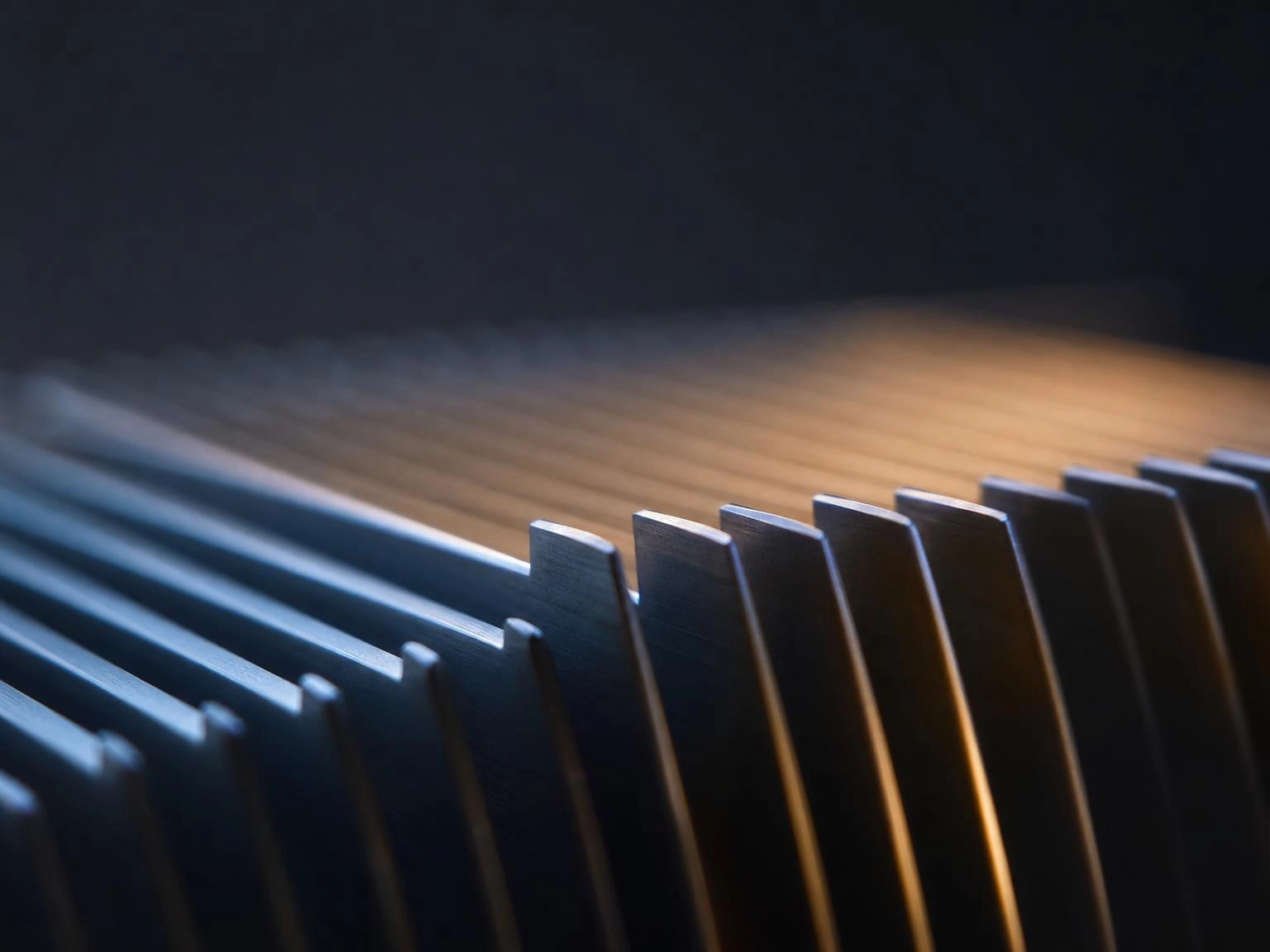
We hold four invention patents and four utility model patents covering heat sink structures, thin-fin radiators, automotive thermal design and new-energy PTC heating. Here is what each one addresses.
We hold four invention patents and four utility model patents. Each one came out of a real customer constraint. Here is what they cover.
Thin-sheet heat dissipation fin structure
Patent 2022231335641 covers a radiator structure using thin-sheet heat dissipation fins.
The engineering problem: conventional thick fins add mass and material cost without proportional thermal gain. Thinner fins increase surface area per unit volume — but they also become difficult to machine, prone to deformation, and harder to bond reliably to the base.
This patent addresses the fin structure so that thin fins can be produced and assembled while maintaining dimensional stability. The benefit to a customer is a lighter heat sink with better surface-area-to-volume ratio at comparable or lower material cost.
Heat sink structure
Patent 2022233157884 covers a general heat sink structure.
This design work focuses on the relationship between base and fin geometry — specifically, on reducing thermal resistance at the base-to-fin junction, where a large share of a heat sink's inefficiency originates. Improving the conduction path at that interface improves overall performance without demanding a larger envelope.
Improved automotive heat sink construction
Patent 2023217304530 covers an improved automotive heat sink construction.
Automotive thermal components face a harsher combination of conditions than most industrial applications: continuous vibration, wide thermal cycling, exposure to moisture and contaminants, and strict dimensional requirements for assembly into a vehicle harness or amplifier chassis.
This patent addresses the structural design of an automotive heat sink for that environment — durability under vibration and thermal cycling while retaining effective heat transfer.
New-energy vehicle heat pump auxiliary PTC heater
Patent 2025204753583 covers a PTC heater for heat pump auxiliary use in new-energy vehicles.
This is our most recent patent and reflects where the market is moving. Electric vehicles have no engine waste heat to scavenge for cabin heating, so heat pump systems are used instead — and at low ambient temperature, a heat pump alone cannot always meet demand. A PTC auxiliary heater fills that gap by adding resistive heating capacity on demand.
The design challenge is combining fast response, accurate control and a fail-safe thermal profile in a package that integrates with the vehicle's thermal architecture. This patent covers that auxiliary heating design.
Why these matter when you are sourcing
The practical value to a buyer is not the certificate itself. It is what the patents reveal about how a supplier thinks.
A manufacturer accumulating patents in heat sink structure, automotive thermal design and EV heating is investing in the categories those patents address. It also means that when you arrive with a difficult thermal problem, there is in-house engineering depth to discuss it — rather than a salesperson promising to "check with the technical team."
We hold certifications as a High-Tech Enterprise and a Technology-Based SME in China, in addition to ISO 9001, ISO 14001 and IATF 16949.
Our honest position on design
We manufacture to your drawings — we do not sell a licensed product line and then find a factory to make it.
If you have a heat sink concept and need a manufacturing partner who can discuss manufacturability, fin geometry limits and cost drivers, that conversation is where these patents become useful to you. Send your drawing and we will give you an engineering-literate response.
Have a thermal design question? Contact [email protected] — include your drawing or a description of the thermal problem and target envelope.
Keywords: heat sink patent, thin fin radiator design, automotive heat sink patent, PTC heater patent, aluminium heat sink manufacturer China